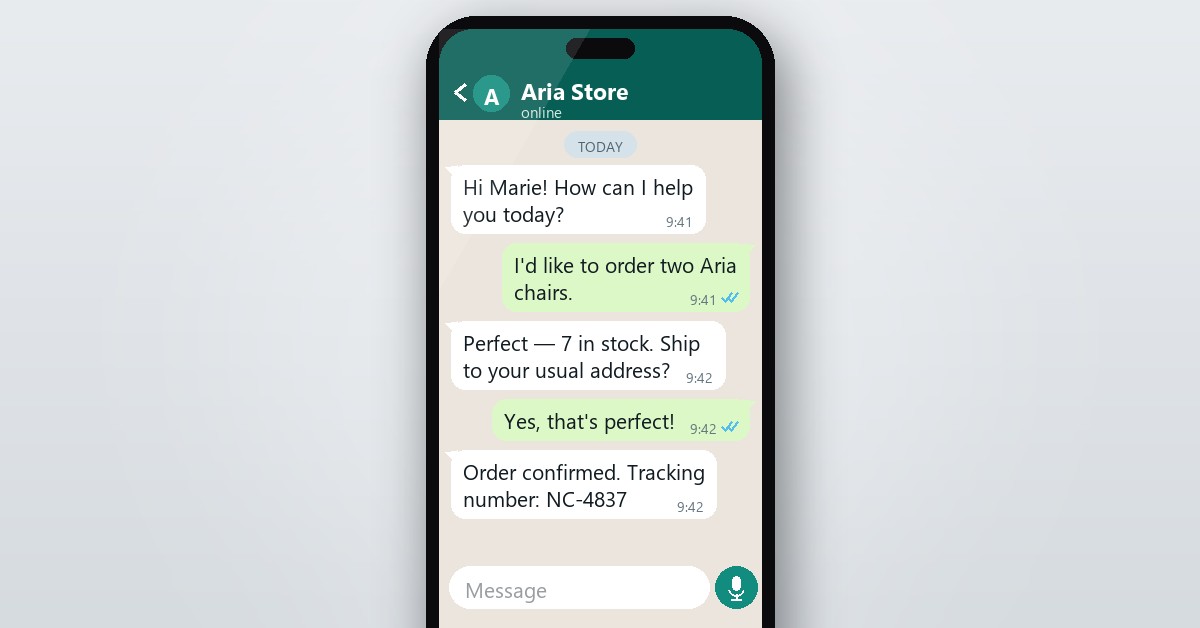
We've heard a lot about artificial intelligence and "chatbots" in recent years. Yet most people have mainly encountered generic assistants: they answer general questions well, but they know nothing about your business, your products, or your customers.
As soon as a question gets specific — "Is model X in stock?", "Can you place my usual order?" — the generic assistant hits its limits.
A custom AI agent is exactly what fills that gap. It keeps a large language model's ability to understand and hold a conversation in natural language, but we connect it to your data and your systems. It then becomes able to answer with your up-to-date information, look things up in your databases, and even perform concrete actions for your customers.
Three capabilities, one progression
To understand what sets a custom agent apart from a simple chatbot, we can sum it up in three capabilities that build on one another.
- Know — The agent is grounded in your knowledge base: product sheets, policies, procedures, FAQs. It answers from your information, not from generalities found on the web. That's the role of RAG, which we cover in a dedicated post.
- Look up — The agent fetches your live data, the kind that changes minute to minute, like a product's stock quantity. It doesn't guess: it queries your inventory in real time, exactly as an employee would in front of their screen.
- Act — The agent performs concrete actions on behalf of a properly identified customer: placing an order, reserving an item, updating a record. This is where the agent stops being a mere information desk and becomes a true collaborator.
Why it changes everything
A generic assistant is impressive, but it stays external to your business. A custom agent, by contrast, works with your data and your processes. The result: accurate answers, round-the-clock availability, and the ability to carry a request all the way to action, with no handoff to a human for routine cases.
And above all, every step stays under your control: you decide what goes into its knowledge base, which data it can look up, and which actions it's allowed to take.
Going further
Other posts explore each of these capabilities in more detail: the RAG, which grounds AI in your knowledge base; the tools, which look up your data in real time; and order-taking for an identified user.
Already have a use case in mind? At Netcoder, we build custom AI agents connected to your business reality. Let's talk.
— Frédéric Brabant